Hi,
I just want to share my current gold Daily chart that show something interesting.
The price has already touch the moving average 200 on 28 Jan 2011 and since then never looking back. Based on the price action, the price may go up to 1750 before any major retracement.
Next, another chart from here
Expected the major retracement would be on jun or july this year but nobody really knows.
The most important thing is never short bullish trend especially precious metal like gold.
Buyers, who have legally contracted to take physical delivery of metals, are said to be accepting large, paper bribes to accept a cash settlement instead.
The reasons are obvious why there has been a great deal of discussion about actual, formal “defaults” in the precious metals markets. Among those “obvious reasons” is that informal defaults are apparently already taking place in both gold and silver markets.
Beginning in the London gold market over a year ago, and now rumored to be occurring in New York’s “Comex” silver futures market, buyers who have legally contracted to take “physical delivery” of the metals they have purchased are said to be accepting large, paper bribes to accept a “cash settlement” instead.
There are many reasons for investors to take such “rumors” seriously. Empirically, we see the premiums being charged for physical bullion (even from large, established dealers) rising to levels never before seen (around the world). This strongly suggests a very tight market for bullion. This is confirmed through the anecdotal reports of both industrial users and large institutional investors (such as Sprott Asset Management) that they are having a great deal of difficulty locating any large quantities of bullion available for sale.
In theoretical terms, we are merely seeing the culmination of arrogant bankers attempting to defy the elementary laws of supply and demand for over a quarter of a century. Even those with no training in economics know the basic rule (since it is merely an expression of common sense): when prices rise, demand falls; when prices fall, demand rises.
There are many derivative principles which flow from this one basic law. Among the most salient (and the one apparently beyond the comprehension of bankers) is that if you under-price any good it will be over-consumed. I have demonstrated the unequivocal truth of this principle previously, and so will not do so again. Suffice it to say that in deliberately under-pricing gold and silver for well over a quarter of a century (through their relentless manipulation of these markets), the bankers have caused more than 25 years of excessive demand – where previous surpluses in these markets have been transformed into huge supply-deficits.
In the gold market, where virtually all of the bullion ever produced has been conserved, this distortion of markets has merely resulted in a massive transfer of bullion: out of the vaults of the West and into the vaults of the East. The situation in the silver market is entirely different.
Being both much cheaper than gold, and possessing even more superior chemical and metallurgical properties, silver was written off by those with no understanding of precious metals as merely an “industrial” commodity. As a matter of common sense, the rapid increase in industrial demand for silver must make it more “precious” rather than less so.
Illustrating this elementary logic, the combination of gross under-pricing and surging industrial demand has served to decimate global silver stockpiles and inventories. Noted silver researcher Ted Butler has estimated that global stockpiles of silver plummeted from over 6 billion ounces (fifty years ago) to approximately 1 billion ounces today. Silver is literally six times “more precious” today than it was a half-century earlier. In terms of “inventories” (the amount of silver actually available for sale today), the destruction caused by the bankers is even more apparent.
Between 1990 and 2005, global silver inventories plummeted by roughly 90%: from over 2 billion ounces to little more than 200 million ounces. Since 2005, there has been a massive inventory-sham perpetrated by the bankers and the quasi-official “keeper of records” for the gold and silver sector: GFMS and the CPM Group.
Through the farcical practice of adding the paper-bullion of silver “bullion-ETF’s” to inventories and pretending this represents “new silver”, inventories have magically “risen” by roughly 400% since then – despite the seemingly incongruous facts that silver demand has increased dramatically, while supply has remained flat.
In fact, any bullion actually held in a bullion-ETF cannot be an “inventory”, since it fails to satisfy the basic definition: it is not for sale, but rather is privately held by the unit-holders of these funds. How can the holders of such funds sleep at night, knowing that the legal “custodian” of their bullion is telling the world that their silver is “for sale”?
Secondly, these holdings of bullion-ETF’s are not “new silver” in any possible sense of those words. The bullion-ETF’s didn’t mine their own silver. They didn’t discover “secret stockpiles”, all they have done is to buy 100’s of millions of ounces of silver out of existing inventories. For the record-keepers of the silver sector to pretend that these funds are “new silver inventories” is nothing but a shell-game of the clumsiest nature.
It is because of the enormous differences between gold and silver inventories that a “default event” is likely to be much different between gold and silver. With gold bullion being principally a financial asset in global markets, it is much easier to forestall a true “failure to deliver” from occurring at the official bullion exchanges (i.e. London or New York) through the unofficial default-mechanism of “cash settlements”.
Indeed, the bankers consider this mechanism to be a “perfect solution” for the parameters of having very finite amounts of (extremely leveraged) bullion, while having access to infinite amounts of banker-paper from central bank printing presses.
In reality, as the “cash settlements” continue to get larger and more frequent, at some point one or more large holders in this banker Ponzi-scheme are going to lose their nerve, and insist on real bullion rather than paper bribes. Such an event does not need to result in an official default. It merely needs to “spook the herd”.
As word gets out of some prominent investor refusing any quantity of banker-paper in favor of physical bullion (i.e. real “money”), this will cause the holders of $100’s of billions of dollars of “paper bullion” products to ask themselves a very pointed question: “am I holding ‘bullion’ or am I holding ‘paper’?”
More importantly will be their response to such a question. The two obvious responses are either to demand delivery or to sell their paper bullion. At that point, it won’t matter which path is taken, since both roads will lead to the obliteration of the bankers’ 100:1-leveraged, paper gold Ponzi-scheme.
If large numbers of bullion-holders demand delivery, there will either be a formal default in London or New York, or a formal default of the bullion-ETF’s – since their “custodians” (the world’s largest bullion “shorts”) will simply walk-away from their commitment to unit-holders in order to cover their own, massive short positions.
If large numbers of paper bullion-holders choose to sell their paper-bullion, this will create a massive decoupling between real “physical” bullion, and the vast quantities of paper-bullion products, where vendors are unable to conclusively prove these funds/accounts are fully-backed.
While the default scenario in the gold market is necessarily complicated, the silver market offers a much clearer picture. The billions of ounces of silver which have been “consumed” industrially are now buried (in tiny quantities) in land-fills all over the Western world. Meanwhile, a large and obvious supply-deficit remains (for any observer not duped by the clumsy inventory-fraud).
This can only end one way. Irrespective of whether the bankers can continue to mollify silver investors with their cash-bribes – and delay a formal default through investor demand alone, obviously this same mechanism cannot possibly work with the vast number of industrial users for silver – who need silver, or many/most of their businesses will cease to operate.
You can’t use banker-paper to make solar cells, lap-top computers, hybrid cars, anti-bacterial textiles, high-precision bearings, or satisfy any of the other myriad industrial applications for silver. Note that the bankers caused all of this incremental industrial demand through their decades of under-pricing silver – and now they have no possible means of meeting that demand.
The only question which cannot be answered for investors (the question which they would like answered the most) is “when will default occur?”
My own answer to this question is simple: the one aspect of “control” which the bankers still exert over the gold and silver markets is the timing of their own funerals. Allow these manipulated, grossly over-leveraged markets to implode today, and prices will soar higher (to multiples of current prices). Attempt to prolong their inevitable demise for several more months (years?), and all that happens is the implosion of these markets is even more catastrophic, with an even greater exponential effect on prices.
Investors should not be troubled by this relatively minor level of uncertainty, as their strategy should be obvious: continue to accumulate precious metals until the bankers self-destruct. The longer we are forced to wait for our final pay-off/validation, the greater the reward for our patience.
Meanwhile, the big-buyers who now rule this market can be expected to march precious metals prices higher – subject to occasional banker-orchestrated pull-backs, since these big-buyers will joyfully accept any “sales” on bullion provided to them by the bankers. The “obituaries” can already be written with respect to the era of banker-manipulation of precious metals markets.
source HERE
For some, the recession has been like Hurricane Katrina. For others, the recession never started. The reality is, unfortunately, that it’s far from over.
Is the recession really (not just technically) over? Is the economy coming back? Are jobs coming back? Obviously, the answers to those questions depend upon whom you talk with. As the old saying goes, “If your neighbor loses his job, we’re in a recession. If you lose your job, we’re in a depression.”
Here in America, the economic news is still pretty dire. A recent survey of college seniors revealed that 85 percent said they planned on moving back in with Mom and Dad. They simply can’t find jobs. The October 25, 2010, edition of USA Today ran the headline: For Many Over 55, Debt Defers Dreams: Recession Strips Away Savings, Jobs. The article states, “The unemployment rate for Americans 55 and older was 7.2% in September, a major increase from 2.9% in September 2006.”
Overseas, the news isn’t much better. The British government recently announced austerity programs that will cut 500,000 government jobs and cut welfare payments drastically. The French rioted in the streets, protesting the retirement age being raised two years from 60 to 62. Japan is now sending work overseas, which means more unemployment in Japan. The Yen’s strength makes Japanese products more expensive. So they seek lower-wage countries to manufacture their products. Toyota is set to produce 57 percent of its product overseas, up from 48 percent in 2005. Nissan will produce 71 percent overseas, up from 66 percent just last year. Bye-bye, Japanese jobs.
What Does This Mean?
Recently, as I was finishing my dinner at a local Italian restaurant, my waiter asked me, “May I talk to you about my mortgage?”
“Sure,” I replied.
“I haven’t paid my mortgage in over 18 months,” he said. “What do you think I should do?”
“Has the bank been calling you?” I asked.
“At first, but lately I’ve heard nothing,” he said hesitantly. “And I’m not the only one. Three of the cooks in the kitchen have also stopped paying their mortgage.”
“And what are you doing with the money?”
“We’re saving it.”
“And what do you plan on doing?” I asked.
“Wait till they take our houses,” he said. “Do you think this is a good idea?”
“I wouldn’t do it,” I said with a smile. “Why are you doing it?”
“Because the mortgage is more than the value of the house. We’re better off not paying the mortgage and saving the money. Let them take our houses.”
I didn’t agree or disagree with this man…yet, silently, I couldn’t fault his logic. Since he was 18 months behind on his mortgage, he was so far behind that he was actually ahead.
As you probably know, the mortgage mess is only getting worse, not better. Many people aren’t paying their mortgages because they don’t have a job. Yet there are a growing number of people who have jobs but who are also refusing to pay their mortgage.
A medical doctor friend of mine confirmed this growing trend. He said the doctors he works with, doctors who make a lot of money, are buying a lower-priced second home and then defaulting on their primary residence.
If this trend turns into an avalanche, the real estate market will crash again. The only people holding onto their homes are people like me, people who purchased before the bubble and don’t owe much, if anything, on their homes.
If there is another real estate crash, it’s people like me -- people who pay their mortgages -- who might be the biggest losers.
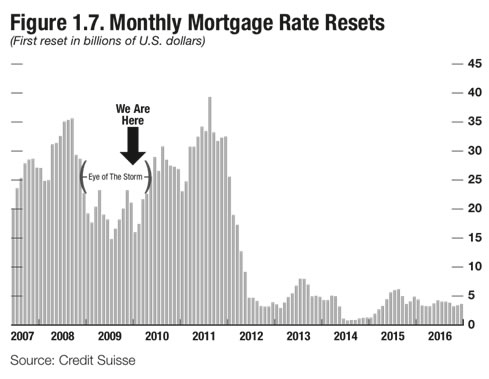
Looking at the chart, it’s easy to see the eye of the storm. The second half of the storm is about to hit.
The leading edge of the storm was the subprime mortgage defaults, the storm that hit in 2007. The trailing edge of the storm will be the defaults of people who are solid citizens, people who have good jobs and good credit.
How severe the second front of the storm will be is yet to be seen. If there are more people like the waiter and cooks in the Italian restaurant and the highly paid doctors who don’t want to pay for a house that is going down in value, the second half of the storm will be very severe.
Good News
The good news is that the Fed and banks are hard at work trying to keep borrowers in place. The Fed and local banks have dropped interest rates, enticing people like me to borrow, borrow, and borrow some more, which I’m happy to do.
Thanks to my latest refinances, my wife and I will save over $7,000 a month in monthly mortgage payments -- that’s $84,000 a year savings. And as far as our rental apartments go, refinancing and saving 2 percent per year on over $100,000,000 in debt is substantial. Even better, since so many people are renting, our apartments are operating at near 97 percent occupancy, even when rents increase.
Bad News
The bad news is that inflation is likely to rise. This will make life even harder for the poor and the middle class. Every time the Fed implements “quantitative easing,” a.k.a. printing more money, two things go up: taxes and inflation. When taxes and inflation go up, more jobs are lost.
Making the situation even worse is President Obama’s Healthcare Reform Bill. In my heart, I understand why he put so much of his term in office to push this bill through. I have relatives who have no healthcare. So for them, the healthcare bill may be a godsend. But for millions of others this bill is their ticket to the unemployment line. The added cost of healthcare is forcing companies to lay off workers.
With Medicare set to go bust in 2019, I wonder how our leaders could pass another program we can’t afford.
So is the recession really over?
For some, the recession has been like Hurricane Katrina. They’ve lost everything in the storm but now the levies are about to break and the flooding will begin. For others, the recession never started. The reality is, unfortunately, that it’s far from over.
What advice do I have?
Over the years, my advice hasn’t changed.
In 1997, in Rich Dad, Poor Dad, I stated, “Your home is not an asset.” Real estate agents sent me hate mail.
In 2007 the first subprime mortgages began to collapse. In 2011, the second wave is about to hit.
In 2002 in Rich Dad’s Prophecy, I stated, “You may have up to the year 2010 to become prepared.”
In 2006 Donald Trump and I wrote Why We Want You to Be Rich, predicting the decline of the middle class. Today the working middle class is slipping into poverty.
For years, I’ve been an advocate for financial education in our schools, and I’ve preached that, as individuals, we must take financial education seriously. Today, my advice remains the same. Until we have comprehensive financial education, we’ll never see the end of our booms and busts.
By Sakina Mohamed
This is the first of a two-part series on Grameen Bank, the first in the world that gives out loans to those who live below the poverty line and revolutionised banking worldwide. The first part explains a brief history of the bank as well as its latest updates and efforts, as revealed by its founder during his recent visit to Malaysia.
KUALA LUMPUR, Dec 29 (Bernama) -- Who has heard the story of a bank that has loaned over USD10 billion to the poor without collateral, yet has a repayment rate of over 98 percent? For those who have yet to hear the story of Grameen Bank, the world's first micro-credit organisation, is indeed an extraordinary one.
Despite defying all the rules of conventional banking, Grameen Bank has single-handedly lifted the Bangladesh poor from poverty. More amazingly, it has even reformed social development and economy not only in the country but across the world.
The man that came up with the idea is now befittingly a Nobel Laureate. Professor Dr Muhammad Yunus, founder and Managing Director of Grameen Bank, started the bank while his country was going through famine in the 1970s. And his inspiration came one morning in 1976, while he was walking past a village to the university in which he served as an economics professor.
"I encountered a poor woman who explained to me that she earned only two cents a day from making these beautiful bamboo chairs, all because she had to borrow from a loan shark. The loan shark had demanded that she sell her products to him at a price so low that she made a profit of only two cents a day".
Muhammad said at that moment, he needed to pay the loan shark only USD1 to set her free from debt and help her out from that cycle of poverty. And so he did.
The happiness and relief in the poor woman inspired him to look for other people in the village who owed the moneylender. He found 42 people who needed a total of only USD27 to pay off the loan shark, as well as to buy raw materials for their businesses. With that amount of money they managed to become debt free and at the same time sell their products to the highest bidder, thus improving their economic status.
In doing so, he found that he had helped the first woman make a profit of USD1.25 a day, instead of only two cents. Thus began a journey for Muhammad to set up Grameen Bank which breaks the cycle of "low income, low saving and low investment".
Muhammad shared the inspiringly famous history of the bank during a luncheon in Malaysia recently, while delivering a keynote address titled "Social Business and Poverty Reduction". The special luncheon was organised by Khazanah Malaysia and the Malaysian Directors Academy (Minda).
BANK FOR THE POOR
Grameen means "rural" or "village" in Bangla. Its tagline is "Bank for the Poor". It provides micro credit to the rural poor in Bangladesh, so that they may start or finance their business and keep their income growing.
Muhammad says the bank lends tiny loans of USD200 per month to about 8.3 million borrowers all over Bangladesh and are paid back in weekly instalments. Amazingly, although the bank lends out to those living below the poverty line, it manages to recoup nearly 98 percent of its loans.
The economics professor says one basic fundamental of the banks since inception is that banks should go to the people and not the other way.
"We meet all these 8.3 million borrowers at their doorsteps. They don't have to go anywhere. We meet them every week and do banking at their doorstep.
"It's a big task. But it's the only way we can get them to do banking with us, as over 97 per cent of our borrowers are women. If you ask them to come to our office, it won't happen. The men will take over, being the mobile ones. Women usually stay home trying to settle numerous tasks in care giving", he explained.
An inevitable question arises: why does Grameen Bank tend to give out loans to women? The bank's website addresses this frequently-asked-question with the following answer:
"Women in Bangladesh are neglected by society. Through the opportunity of self-employment and the access to money, Grameen Bank helps to empower women. In addition, studies have shown that the overall output of development is greater when loans are given to women instead of men, as women are more likely to use their earnings to improve their living situation and to educate their children".
BANKING FOR EDUCATION
Today Grameen Bank is owned by the rural poor whom it serves. Borrowers of the bank own 90 percent of its shares, while the remaining 10 percent is owned by the government.
While watching the success of Grameen Bank in elevating the living standards of its borrowers, another question came to Muhammad's mind: what will become of the future of their families?
It was a natural question to ask, considering that the parents are mostly illiterate. This almost guarantees the perpetuation of the traditional cycle of poverty, ill health and other social maladies that come with it.
"We decided that we must ensure the children of all these families go to school in order to break out of that cycle and move on to a different direction", he says. So that plan was then set into motion.
Then a wonderful and unexpected thing happened. The children not only went to school, but thrived and excelled in their studies. They soon found themselves going to high schools and subsequently, colleges.
"There were thousands of them, flourishing and excelling in school. We didn't at all expect this as we thought having them go to primary school was the best achievement we could hope for from these Grameen kids. But the reality turned out to be much better than we expected", he says.
But then another problem surfaced. While parents were happy that their children were progressing academically, they soon realised that the cost of tertiary education was beyond their means.
"So then we had scores of children who were academically excellent but couldn't further their education. We debated within Grameen bank on how best to ensure that they stay on, and we came up with this solution - to introduce the education loan. Now, nobody is left behind".
As a result, there are now more than 50,000 students with Grameen education loans in medical schools and engineering schools in universities across Bangladesh.
Muhammad believes that children from wealthy families are no different than the poor ones in terms of capabilities. However, opportunity-wise, there is a big difference.
"And that makes all the difference in their lives.
"If the poor children could go to the best schools in the world and compete with their best talents, they'll be as capable and as talented as everyone else."
GRAMEEN STUDENTS IN MALAYSIA
Muhammad speaks fondly of Malaysia and his relationship with Khazanah Chief Executive Officer Tan Sri Azman Mokhtar. The former has visited Malaysia many times, even before the Grameen idea took off outside of Bangladesh.
"Malaysia is almost like my second home. In fact, the first time the Grameen idea was taken outside of Bangladesh was in Malaysia, with the first application in Penang", he revealed.
In 1994, Malaysia bestowed Muhammad the Tun Abdul Razak award in recognition of his remarkable contribution to the world. Since Grameen Bank's inception in 1976, he founded 25 companies, all of which aimed at improving the living situation of the poor.
He says on hearing his sentiments on education, Azman immediately come up with idea of providing scholarships to Grameen students to study in Malaysia.
Today, Yayasan Khazanah sponsors 10 students who are children of Grameen Bank employees in select universities in Malaysia via the Khazanah Asia Scholarship. The foundation also continues to annually select five students from families that are served by the Grameen Bank to be recipients of the scholarship.
"The students that get this fantastic opportunity are from families with very low income", explains Muhammad.
He describes the programme as one that binds both Grameen and Khazanah very closely and says he is happy with the partnership.
Today, the bank is the source of ideas and models for many institutions in the field of micro-credit. But in Bangladesh, it represents a whole lot more.
"It is the future of the second generation of borrowers", says Muhammad.
"Of where they can go, and what they can be. They no longer have to go back to age-old cycle of poverty. They can now take it forward".
-- BERNAMA
Who doesn't like the fresh start of a new year? A clean slate and an optimistic outlook make January 1 a magical time. The only problem is that every year we vow to take care of our finances, but we ultimately get sidetracked with excuses. But this year will be different, and to help, here are some smart money moves for the New Year.
Review the previous year
What better place to begin a new year than to reflect upon the past? Take a look at last year's budget, identify the good and bad money moves you made last year and resolve to make the necessary improvements for the upcoming year.
Set one financial goal
Keep it simple this year and set at least one goal you'd like to achieve by the end of this year, then put all of your focus and energy towards achieving the goal.
Some financial goals could be to:
— Automate your finances
If your money seems to slip through your fingers before you can save any of it, putting yourself on an automatic savings plan to debit even $50 per month from your account is a good way to save without feeling the pinch. If you don't see the money, you won't miss it and before you know it, that $50 per month in savings will be $600 at the end of the year.
If your problem is more that you keep forgetting to pay bills and end up paying interest on overdue bills, you can also automate your bill payments by calling the companies directly to ask if they can debit your account every month, or talk to your bank about automating your recurring bill payments.
— Improve your investing knowledge
This is probably the area most people are afraid of. Of course it will all look confusing to begin with if you want to tackle everything under the sun in a short amount of time. So start slow and simple with something like learning what bonds, stocks and mutual funds are. For each topic, apply your newfound knowledge towards your money so that the information becomes relevant to you.
Your company might also offer free seminars to understand your finances better. You can also go online to learn the basics at your own pace.
— Get out of debt
For anyone who is in debt, it is really better knowing what your financial situation is than to stay in the dark. Next, create a budget listing your net income per month and where you plan to spend your money in each category.
Once your budget is done and you know what you have to work with, make a separate plan to get out of debt. Start by listing all of your debts, their interest rates and minimum monthly payments.
Now minus the total amount of minimum debt repayment you'll have to make each month, and whatever is leftover should be applied to either the lowest debt balance you have or on the debt with the highest interest rate.
As you clear each debt, take the amount you used to pay towards that debt and apply it to the next debt in line until you're debt-free.
You may find that your minimum payments equal or exceed 15 percent of your net income. In that situation, you will need to adjust your budget percentages and cut back on your housing, life or transportation costs, or simply make more money.
Don't rob your savings category in the beginning to pay down your debt. You should save a minimum of $1,000 for emergencies before adjusting your savings.
Investopedia.com: Top 5 budgeting questions answered
Make a plan
Keep it simple and make sure you've covered all the bases for each goal. For example:
Goal: Save $5,000 by the end of the year for an exotic holiday vacation.
Step(s): Save an additional $417 per month, or $208.50 per bi-weekly paycheck.
The Plan: Review your budget and set up an automatic withdrawal from your paycheck into a savings account.
The bottom line
There are plenty of other goals out there, such as buying a home, a new car or going on a European vacation. The main thing to remember is that without a plan, your goals will always be dreams.