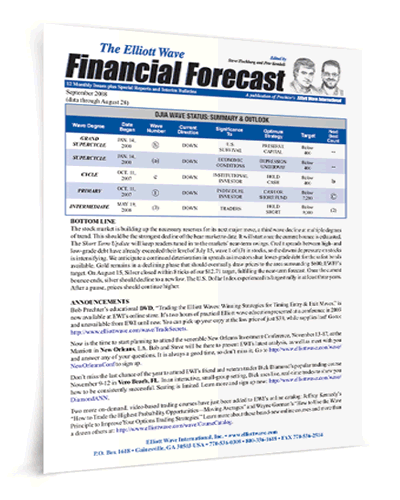
"The crash is over", says an economist. "Housing can only go up," says another. "I think the market has bottomed out," says one builder. "It appears we have turned the proverbial corner," says a second.


After hitting a low with stocks in March 2009, U.S. single family building permits rallied in three waves into March 2012. The latest high is more than 65% below the September 2005 peak. A MarketWatch commentary insists, "Permits Push Signals U.S. Housing Boom." These assessments are flooding in even though many home buyers from 2010 and 2011 are already underwater! According to CoreLogic, more than one millions U.S. home buyers who have taken out low-money-down FHA mortgages over the last two years already owe more on their loan than their homes are worth. The FHA's policy of accepting almost no money down is deadly when..... continues in the May issue of EWI's Financial Forecast 10 page report available for FREE.
Download this special issue for free, but fair warning: It's only available until Thursday, May 31.
Here's a quick summary of what you'll find inside:
  • Europe's debt crisis.
  • European political crisis.
  • Charts flashing danger signals.
  • What U.S. stock investors should know NOW.
  • Sentiment analysis.
  • Tech Stock signals for Apple, Google and Amazon
  • NYSE margin debt signal.
  • Facebook special.
  • And much more, including detailed Elliott wave charts and insights on gold,silver, bonds, the U.S. dollar, the economy, inflation vs. deflation and real estate
Learn More and DOWNLOAD EWI's NEW 10-page May 2012 Elliott Wave Financial Forecast here - It's FREE. (requires a valid email address).

About the Publisher, Elliott Wave International Founded in 1979 by Robert R. Prechter Jr., Elliott Wave International (EWI) is the world's largest market forecasting firm. Its staff of full-time analysts provides 24-hour-a-day market analysis to institutional and private around the world.

source

Posted by Mr Thx Monday, May 28, 2012 0 comments

Spain is a catastrophe on such a level that few analysts even grasp it.
Indeed, to fully understand just why Spain is such a catastrophe, we need to understand Spain in the context of both the EU and the global financial system.


The headline economic data points for Spain are the following:
  • Spain’s economy (roughly €1 trillion) is the fourth largest in Europe and the 12th largest in the world.
  • Spain sports an official Debt to GDP of 68% and a Federal Deficit between 5.3-5.8% (as we’ll soon find out the official number)
  • Spain’s unemployment is currently 24%: the highest in the industrialized world.
  • Unemployment for Spanish youth is 50%+: on par with that of Greece
On the surface, Spain’s debt load and deficits aren’t too bad. So we have to ask ourselves, “Why is unemployment so high and why are Spanish ten year bills approaching the dreaded 7%?” (the level at which Greece and Portugal began requesting bailouts).
The answer to these questions lies within the dirty details of Spain’s economic “boom” of the 2000s as well as its banking system.
For starters, the Spanish economic boom was a housing bubble fueled by Spain lowering its interest rates in order to enter the EU, not organic economic growth.
Moreover, Spain’s wasn’t just any old housing bubble; it was a mountain of a property bubble (blue line below) that made the US’s (gray line below) look like a small hill in comparison.

continue here

Posted by Mr Thx Tuesday, May 1, 2012 0 comments

Malaysia - Exchange Rate Policy - Nov 10 2011

MALAYSIA CURRENCY FORECAST

Spot
Ave-11 Ave-12
MYR/US$ 3.1200
3.1100 3.1800
MYR/EUR 4.2714
4.4500 4.3800
Overnight Policy Rate (%) 3.00
3.00 3.00
Source: BMI, November 10 2011

Short-Term Outlook

We see increasing risks that the Malaysian ringgit could experience further selling pressures over the coming weeks due to resurfacing troubles in the eurozone. Following a sell-off across regional currencies in September, the Malaysian ringgit depreciated by around 7.5% before finding support at MYR3.2048/US$. Further negative developments in the eurozone could see the ringgit retesting its recent low of MYR3.2048. A break below this level would present significant downside risks to our year-end target of MYR3.1500/US$ for the currency.
External Headwinds Remain
Malaysia - Malaysian Ringgit Spot, MYR/US$
Source: Bloomberg, BMI

Core View

Global economic headwinds, including the sovereign debt crisis in the eurozone and growing concerns of a hard-landing in China, should spell further weakness for risk-on currencies including the Malaysian ringgit over the coming months. However, despite these downside risks to the Malaysian ringgit's outlook in the short term, we expect the country's robust current account dynamics to provide support for a steady appreciation in the currency over the medium term. Furthermore, a positive economic outlook should underpin strong foreign direct investment (FDI) inflows and fuel demand for the ringgit over the coming quarters. Nonetheless, we expect further weakness in the currency in H112 before the ringgit resumes its bullish uptrend in H212. This means that the ringgit should average at around MYR3.1800/US$ in 2012 before strengthening to MYR2.8500/US$ by end-2013.

Despite cooling external demand, Malaysian exports have remained resilient in recent months. Trade exports grew 10.8% year-on-year (y-o-y) in August (up from 6.9% y-o-y in July) while outpacing that of imports at 6.8%, resulting in a healthy trade surplus of US$3.7bn. Although we expect the trade balance to narrow over the coming months, a surplus would nonetheless be positive for the ringgit. Meanwhile, FDI inflows are likely to remain strong in 2011 due to a positive response from foreign investors towards the government's ambitious Economic Transformation Plan (ETP). In fact, we have already seen compelling evidence that investor optimism over the ETP has been a key factor behind the surge in capital inflows into Malaysia in 2011. According to a survey conducted by the International Trade and Industry Ministry, local and foreign private sector companies are expected to commit MYR50.6bn (US$16.8) worth of investments in 2011. We are optimistic that these FDI inflows should provide further support for the currency over the coming quarters.

Strong Cushion Of Reserves
Malaysia - Foreign Reserves, US$mn
Source: Bloomberg, BMI
According to figures published by Bank Negara Malaysia (BNM), the recent wave of selling pressure in the foreign exchange market drained the country's foreign reserves by 4.1% from US$134.5bn in August to US$129.1bn by the end of September. However, it is worth noting that the central bank's intervention in the foreign exchange market is largely aimed at limiting short-term volatility in the exchange rate, rather than an attempt to defend against a balance of payments deficit. As the accompanying chart shows, despite the central bank's intervention, the country's foreign reserves remain above its pre-crisis peak. Our view that Malaysia's trade balance will remain in surplus while FDI inflows will continue to grow over the coming quarters means that we should see a continued accumulation of reserves.

We note that movements in the Malaysian ringgit and the Chinese yuan are highly correlated as a result of BNM's conscious efforts to keep Malaysian exports competitive. Given that we expect external demand to remain relatively subdued in 2012, export growth should continue to slow over the coming months. This poses a risk that the BNM may seek to limit any significant gains for the ringgit in order to prop up exports.


Catching Up With The Yuan ?
Asia - Spot MYR/US$ (LHS) & 12-Month CNY/USD NDF outright (RHS)
Source: Bloomberg, BMI

Risk To Outlook

FDI inflows will play a major role in sustaining a steady appreciation in the Malaysian ringgit over the coming quarters. To a great extent, this is heavily dependent on the successful implementation of the government's ETP. We warn that Malaysia's deteriorating fiscal position, which we expect to amount to a deficit of 5.6% of GDP in 2012, represents a significant risk to the government's ability to implement the ETP. Should investor sentiment start to wane on the back of growing concerns that the government could face difficulties in financing the ETP, a slowdown in FDI inflows would mean that the currency could see limited gains in H212.

source

Posted by Mr Thx Wednesday, April 11, 2012 0 comments

Myanmar - Economic Activity - Dec 06 2011

BMI View: On the heels of recent surprisingly fast-paced reforms, potential opportunities for Myanmar's economy are perhaps the highest they have been in over five decades. Moving forward, the economy could be set for a boom period in real estate, tourism, construction, and exports, but much will depend on the government's continued push towards reform and the eventual lifting of stifling US and EU sanctions. We see the Myanmar economy growing by 5.0% in 2012 following a 6.0% performance in 2011 even as growth in the rest of the world falls more sharply given the country's unique prospects of economic liberalisation.
 
One of Asia's best educated and wealthiest states prior to a military coup in 1962, Myanmar is now bereft with a cumbersome dual-rate exchange system, a major infrastructure deficit, and heavy sanctions from the US and EU following almost five decades of failed economic policy. However, on the heels of an election that was widely derided as a rigged handover of power from the military to its own factions in 2010, change may finally be coming in earnest to the beleaguered resource-rich state. 

The culmination of recent (and surprisingly strong) reform efforts was US Secretary of State Hillary Clinton's November 30 visit to Myanmar, during which she met with President Thein Sein and political activist Aung San Suu Kyi. The visit represented the first time such a high level official from the US had visited Myanmar since 1955 and heralded a major thaw in relations between the two countries. Following such an extended period in isolation, the recent pace of change has been relatively breakneck and could open up myriad opportunities for Myanmar's struggling economy. 

Dependence On China To Wane

Myanmar's sudden shift towards political reform is highly indicative of its intentions to stem its growing reliance on giant neighbour China. Over the past 18 months, Myanmar has received 20% more foreign direct investment inflows than it had over the preceding 20 years combined, with China responsible for 70%. President Thein Sein's September decision to halt the China-backed US$3.6bn Myitsone dam project signalled that the new government is serious about balancing the playing field with China, and to do so, Naypyidaw has now turned towards the West.

Shooting Higher
Myanmar - Stock Of Foreign Direct Investment, US$mn
Shooting Higher - Myanmar - Foreign Direct Investment, US$mn

Source: BMI, UNCTAD, Myanmar CSO

This is not to say that Myanmar's relationship with China is likely to deteriorate precipitously. Given China's thirst for Myanmar's natural gas and copper resources, and Myanmar's continued need for Chinese investment, the two countries' mutual interests promise to keep relations close. Moving forward, China is very likely to remain Myanmar's closest ally and largest investor as was indicated by head of Myanmar's armed forces General Min Aung Hlaing's auspicious visit with putative future Chinese president Xi Jinping just days before Clinton's arrival. 

Lifting Of Sanctions Could Usher In New Era

Still, détente with the US in particular could present monumental economic opportunities for Myanmar. Since 1997, the US has forbidden all new investment by American companies into Myanmar as well as most Myanmar exports to the US. While the US has repeatedly stated that Myanmar's government will have to show considerably more progress on the political reform front before it can consider reducing or lifting sanctions, Clinton's visit is a major step forward, indicating that the US is likely to reward Myanmar further if the reform process moves ahead. 

The lifting of sanctions by the US and EU would solidify Myanmar's re-emergence into the international economy and could eventually set the stage for the country to build its own economic miracle. Rich in natural gas, timber, gems, metals, and myriad other valuable natural resources, Myanmar could potentially become a resource exporting powerhouse. Furthermore, with a literacy rate near 85% and at least 5mn English speakers nationally (most of whom live in Yangon) out of a total population near 60mn, Myanmar possesses considerable human capital.

Secondary Axis Required
Asia - Annual Exports Of Goods, US$bn (Myanmar RHS)
Secondary Axis Required - Asia - Annual Exports Of Goods, US$bn (Myanmar RHS)

Source: BMI

Still, it should be noted that corruption remains extremely widespread across Myanmar and will continue to plague its poor business environment for an extended period despite even swift wide-ranging reform. Myanmar's current state is underscored by Transparency International's most recent Corruption Perceptions Index rankings, which place the country second worst in the world, tied with Afghanistan and above only Somalia. 

Real Estate, Tourism Set To Boom?

In the short term, Myanmar's real estate and tourism sectors stand to gain immensely from an opening of the economy. In stark contrast to just one year ago, when struggling local hoteliers were converting chronically vacant rooms to office space, room shortages are already cropping up in the country's largest and most economically active city, Yangon, as businessmen and tourists alike are drawn towards the country's rapidly changing atmosphere.
In the real estate sector, even though prices have risen for every year for the past 20 years (according to media and anecdotal reports), the hopes that reform will lead to reduced limitations on foreign ownership should keep already lofty prices underpinned through 2012. 

With cash being far too risky for most wealthy Burmese to hold and foreign banking not an option for almost anyone holding a substantial amount of wealth, rich Burmese have plunged their capital into real estate, sending the market surging over the past few years. Prices have been reported as high as US$1,245 per square foot in the most sought after locations in Yangon, with properties in some upscale neighbourhoods hovering around US$375 to US$625. 

Still, if and when serious economic reforms take place, foreign demand could lead to massive speculation in the market, driving prices even further skywards over the medium term in what remains an exceedingly underdeveloped market. Furthermore, whereas booming property prices have thus far been restricted to a very limited section of Yangon, they could begin to spread rapidly should economic reforms move ahead as hoped. In such a scenario, a lack of office space in Yangon (where there is only 540,000 square feet of office space, or the equivalent of one New York skyscraper) and across the country is also likely to portend a construction boom. 

Kyat Could See Further Strength

Despite having the brightest outlook in nearly six decades, the Myanmar economy still faces major challenges before it can enter the pantheon of South East Asian miracle countries like Vietnam and Thailand. Standing in its way is a dilapidated exchange rate mechanism, where the black market rate of the Myanmar kyat to the US dollar is more than 120 times greater than the official government rate. As the official government rate of MMK6.4355/US$ is rarely (if ever) used to settle transactions, the black market rate, currently at MMK776.00/US$, is the effective exchange rate. 

Although the government is working with the IMF in order to move towards a single-rate mechanism, it lacks the ability to control the currency in a meaningful way. In light of the suddenly reform-minded government, as well as historic communication with the US, we now see the possibility of continued strength in the kyat despite it having appreciated more than 20% over the past two years. As the economy opens up, foreign demand for the kyat will surge, underpinning the currency's already strong historical price. 

Significant Upside Risks To Growth Forecast

Despite the growing chance of renewed recession in the US and EU, Myanmar's starting position as a nearly completely isolated economy means that it bears little exposure to the global economy's woes. As a result, risks to our growth forecast of 5.0% for 2012 are weighted heavily to the upside. Should either the US or EU ease sanctions considerably, we would consider revising our forecast upwards. 

 
MYANMAR - ECONOMIC ACTIVITY

2011 2012 2013 2014 2015 2016
Nominal GDP, MMKbn 1 45,024.2 f 51,648.3 f 59,247.1 f 67,963.8 f 77,963.0 f 89,433.3 f
Nominal GDP, US$bn 1 55.5 f 60.9 f 67.1 f 74.0 f 81.6 f 90.0 f
Real GDP growth, % change y-o-y 1 6.0 f 5.0 f 5.0 f 5.0 f 5.0 f 5.0 f
GDP per capita, US$ 1 890 f 956 f 1,033 f 1,117 f 1,207 f 1,305 f
Population, mn 2 62.4 f 63.7 f 65.0 f 66.3 f 67.6 f 68.9 f

Notes: f BMI forecasts. Sources: 1 Asian Development Bank. 2 World Bank/UN/BMI.

Posted by Mr Thx 0 comments

Iraq - Fiscal Policy - Nov 10 2011

BMI View: Iraqi Finance Minister Rafi al-Eisawi's plan to reduce the budget deficit by two-thirds, which relies on increasing oil exports and privatising state-owned enterprises, is feasible but will require a significant degree of political will in order to reform the business environment. Given our view that political instability will retard the pace of reforms, we maintain our budget deficit forecasts of 2.7% and 2.6% of GDP in 2012 and 2013 respectively.
 
The Iraqi government's goal of reducing its budget deficit by two-thirds by the end of 2014 is achievable, though will require a high degree of political will. On October 22, media sources quoted Finance Minister Rafi al-Eisawi as stating that the government planned to reduce the budget shortfall by increasing oil production and privatising state-owned enterprises (SOEs). Given the high degree of political instability in the country, we expect the business environment reforms necessary to attract foreign investment into SOEs will take a significant amount of time to enact (and therefore lead to but a few acquisitions, if any, over the medium term). Therefore, we maintain our budget deficit forecasts of 2.7% and 2.6% of GDP in 2012 and 2013 respectively. 

Hydrocarbons Are The Easier Route

Fiscal revenues are set to increase dramatically over the coming years, mostly due to advances in hydrocarbon production that will allow for greater exports. Our Oil and Gas research team projects oil production to rise from an average of 2.8mn barrels per day (b/d) in 2011 to 7.5mn b/d by 2016, with export volumes rising from 2.0mn b/d to 6.6mn b/d over the same period. Although we foresee declining international energy prices over the medium term, from an average OPEC basket price of US$102 per barrel (/bbl) in 2011 to US$99/bbl in 2012 and US$97/bbl in 2013, the effect of rapidly rising oil production, and in turn exports, will cause oil revenues to rise sharply (see accompanying chart). 

Hydrocarbon Revenues To Pour In
Iraq - Forecasts For Value Of Petroleum Exports
Hydrocarbon Revenues To Pour In - Iraq - Forecasts For Value Of Petroleum Exports, US$mn

Source: BMI

Privatisations Entail Greater Complexity

Privatisation is another potential source of revenues, according to Eisawi, but we see several obstacles to successful sales of SOEs. Reforming the economy from a state-centric system to a market-based one is a high priority for the government, and there is certainly a large pool of potential assets available for privatisation (with 177 state-owned firms in the country). Approximately 43% of all Iraqi state-owned firms (a total of 76 enterprises) fall under the authority and supervision of the Ministry of Industry and Minerals (MIM), with ownership of 250 factories. Sectors span the areas of agriculture, transportation, telecommunications, utilities, construction, hydrocarbons, and financial services, among others, and given the high rates of growth that the country is projected to see (see our online service, November 8, 'Double-Digit Growth Ahead'), many of these could be attractive targets for investors. 

A Large Pool Of Potential Assets For Sale
Iraq - Breakdown Of Number Of SOEs By Ministry
A Large Pool Of Potential Assets For Sale - Iraq - Breakdown Of SOEs By Ministry

Source: BMI, Iraq Task Force For Economic Reforms/UN/World Bank

That said, we note that there a number of obstacles to the privatisation plans, and a high degree of political will would be required to ensure that the business environment is attractive enough for investors to bid. The lack of a favourable environment has proven to be a decisive factor in previous failed attempts by the MIM to establish public-private partnerships (PPPs) between SOEs under its authority and investors, according to the US Special Inspector General For Iraq Reconstruction (SIGIR). 

A series of laws have yet to be updated in order to address potential legal issues of privatisation, and while an Economic Reform Law is currently being developed, changes also need to be made to the country's Companies Law and Investment Law. Furthermore, investors would need assurances that they would not receive any legal backlash from laying off workers (as many SOEs have excessively large payrolls). However, there are significant concerns regarding political stability in the country, which will slow down the pace of reforms and dampen investor interest (see our online service, October 19, 'Mounting Challenges To Stability'). 

Success Would Help On P&L

Should Baghdad succeed in spinning off even a few of its SOEs, we would expect to see substantial benefits. First, the government would see a large (albeit temporary) source of new revenue. Second, and more importantly, fiscal expenditures related to maintaining state-owned firms would decrease, boding well for the budget. Many SOEs have suffered heavy damage to their assets, rendering the firms inoperable and therefore unable to earn revenues, yet workers are kept on payrolls and paid from government coffers. Others are able to function but have a bloated workforce. These firms collectively employ over 633,000 workers, and employee compensation expenses took up 41.5% of total fiscal expenditures (US$22.8bn out of total expenses of US$55.0bn) in 2010. Thus, privatisations would have a major impact on both revenues and expenses. 


IRAQ - FISCAL POLICY

2008 2009 2010 2011 2012 2013 2014 2015 2016
Fiscal revenue, IQDbn 2 80,252.0
55,209.0
69,521.0 e 104,192.9 f 139,873.7 f 187,050.4 f 220,897.2 f 258,395.4 f 304,708.9 f
Revenue, % of GDP 2 51.6
43.8
45.0 e 51.2 f 56.8 f 62.5 f 64.7 f 66.7 f 68.8 f
Fiscal expenditure, IQDbn 2 59,403.0
52,567.0
64,351.0 e 104,425.2 f 146,436.1 f 194,760.0 f 228,577.7 f 261,439.3 f 291,748.0 f
Expenditure, % of GDP 2 38.2
41.7
41.7 e 51.3 f 59.5 f 65.1 f 66.9 f 67.4 f 65.9 f
Budget balance, IQDbn 2 20,849.0
2,642.0
5,170.0 e -232.3 f -6,562.4 f -7,709.6 f -7,680.5 f -3,043.9 f 12,960.9 f
Budget balance, % of GDP 2 13.4
2.1
3.3 e -0.1 f -2.7 f -2.6 f -2.2 f -0.8 f 2.9 f
Primary balance IQDbn 1,2 21,757.0
3,343.4
5,988.3 e 3,745.7 f -2,584.4 f -2,912.6 f -2,680.5 f 1,956.1 f 17,960.9 f
Primary balance % of GDP 1,2 14.0
2.7
3.9 e 1.8 f -1.0 f -1.0 f -0.8 f 0.5 f 4.1 f

Notes: e BMI estimates. f BMI forecasts. 1 Fiscal balance stripping out interest payments on government debt; Sources: 2 CBI/BMI.

Posted by Mr Thx Tuesday, April 10, 2012 0 comments
Related Posts Plugin for WordPress, Blogger...

Sekapur Sirih Seulas Pinang

My photo
Alor Gajah, Melaka, Malaysia
Sharing is caring. This blog is about sharing information that available in web space. The information is related to Finance, Business & Trading.

Enter your email address:

Delivered by FeedBurner

Malaysia